
Keweenaw County Arrest Records and Court Charges
A Keweenaw County arrest record captures the arrest event itself. It names the agency or officer who made the arrest and reflects the booking that follows a person being taken into custody. In Keweenaw County the Sheriff's Office is the only law-enforcement agency based inside the county, so most local arrests run through its deputies. The arrest is a law-enforcement action. It is not yet a formal accusation in court.
The court charge record is a separate file. After an arrest, the county prosecutor reviews what happened and decides which charges to authorize, then files them with the court, where they become the charge record. Booking and custody detail belong to the jail side, so for the roster and lockup status see the Keweenaw County inmate records page. Court charges after arrest are tracked through the case itself, and the full case file, pleas, and final outcome sit on the criminal court records page.
How to Find Keweenaw County Arrest Records and Charges
Charges and their current status show up in the court case index rather than in a jail blotter. The statewide MiCOURT Case Search portal is the main free online tool, and it may return criminal, traffic, civil, domestic, and probate cases depending on the court searched. Michigan Courts limits public web records to case number, party names, and the case history, so treat any result as an index and go to the clerk for the full file.
- Open the MiCOURT Case Search portal and choose the Keweenaw County court where the case sits.
- Search by the defendant's name, or enter the case number from a citation, notice, or clerk letter for an exact match.
- Open the matching case and read the charge list along with the register of actions.
- Check each charge for its statute code, its level, and its current status.
Some records are not online. Older files, certified copies, and cases not in the portal come from the court clerk directly. The Michigan Courts records-management guidance explains why web results are limited, and the 12th Circuit Court and 97th District Court clerk at 906-337-2229 can confirm charges, bond, and hearing dates by phone.
Who Files Charges After an Arrest in Keweenaw County
Charges do not come from the arresting deputy alone. The Keweenaw County Prosecuting Attorney, Charles Miller, authorizes and prosecutes criminal charges for the county. The prosecutor page states that the office's main job is to work with law enforcement so that people who commit crimes in Keweenaw County are fully and fairly prosecuted.
In practice, the prosecutor weighs the arrest report, the evidence, and the applicable statute, then authorizes a complaint and warrant when charges are warranted. Those charges are often first visible in the 97th District Court at the first appearance. A person can be arrested and released without the prosecutor ever filing charges, which is one reason the arrest record and the charge record do not always match.
Charging Documents: Complaint, Information, and Indictment
Trace a case from the arrest forward. The arrest and booking happen first. The charge record then begins the moment the prosecutor files a charging document with the court. Michigan uses three main charging documents, and each one names the charges, cites the statute, and identifies the court that will hear the matter.
| Complaint | Information | Indictment | |
|---|---|---|---|
| Filed By | Officer with prosecutor authorization | Prosecutor | Grand jury |
| Common For | Misdemeanors and initial felony charges | Felonies sent up after bindover | Serious felonies |
| Court | 97th District Court | 12th Circuit Court | 12th Circuit Court |
| Role | Starts the case | Formal felony charge in circuit | Charge returned by citizens' panel |
Most Keweenaw County cases begin with a complaint. For a felony, the District Court holds a preliminary examination, and if the case is bound over, the prosecutor files an information that becomes the formal charging document in the 12th Circuit Court. Indictments are far less common in a small rural county.
Charge Status and What It Means in Keweenaw County
Charges rarely stay frozen. As a case moves, a charge can be amended, reduced, added, dropped, dismissed, or bound over to a higher court. The register of actions records each change, so the status you see today may differ from the charge listed at the arrest. Reading the status correctly keeps you from mistaking an early charge for a final result.
| Status | What It Means |
|---|---|
| Pending | The charge is active and the case has not reached a plea, verdict, or dismissal. |
| Amended / Reduced | The prosecutor changed the charge, often to a lesser offense, so the wording or level differs from the original. |
| Dismissed | The court dropped the charge, so it no longer moves toward a conviction. |
| Nolle Prosequi | The prosecutor formally chose not to pursue the charge, ending it without a conviction. |
| Bound Over | A felony charge cleared the preliminary examination and moved from the 97th District Court to the 12th Circuit Court. |
Felony and Misdemeanor Charge Routing in Keweenaw County
Every charge is tied to a statute. Michigan charges cite a Michigan Compiled Laws section, and that citation fixes both the offense and its severity. Severity decides which court handles the charge. Misdemeanors carry lighter maximum penalties, while felonies carry the heaviest, and a single arrest can produce several separate charges that travel at different speeds.
The 97th District Court handles misdemeanors punishable by up to one year, along with felony first appearances and preliminary examinations. Felony charges that survive the preliminary examination are bound over to the 12th Circuit Court, which holds the felony trial and sentencing. Because both courts share the courthouse phone line at 906-337-2229, callers should say whether the matter is a misdemeanor or a felony so staff can point them to the right file.
A single charge entry in the court record usually shows the statute cited, the offense level, the filing date, and the current disposition. It also ties to the wider case data, such as the case number, the party names, and the register of actions that logs each hearing and order. Reading the charge alongside those fields tells you not just what was filed after the arrest, but where the charge stands now.
Charges vs. Convictions
Being charged is not the same as being convicted. A charge is only an accusation, filed on probable cause, and the accused is presumed innocent until the case ends. A conviction is the final result after a plea or a verdict, reached only when guilt is proven beyond a reasonable doubt. Arrest records and charge records both show the accusation stage, not the outcome.
| Charge | Conviction | |
|---|---|---|
| Stage | Accusation | Verdict or plea |
| Burden of Proof | Probable cause | Beyond reasonable doubt |
| Can Change | Amended, reduced, or dropped | Final unless appealed or set aside |
| Public Record | Yes | Yes |
Statewide Charge and Criminal History Lookups
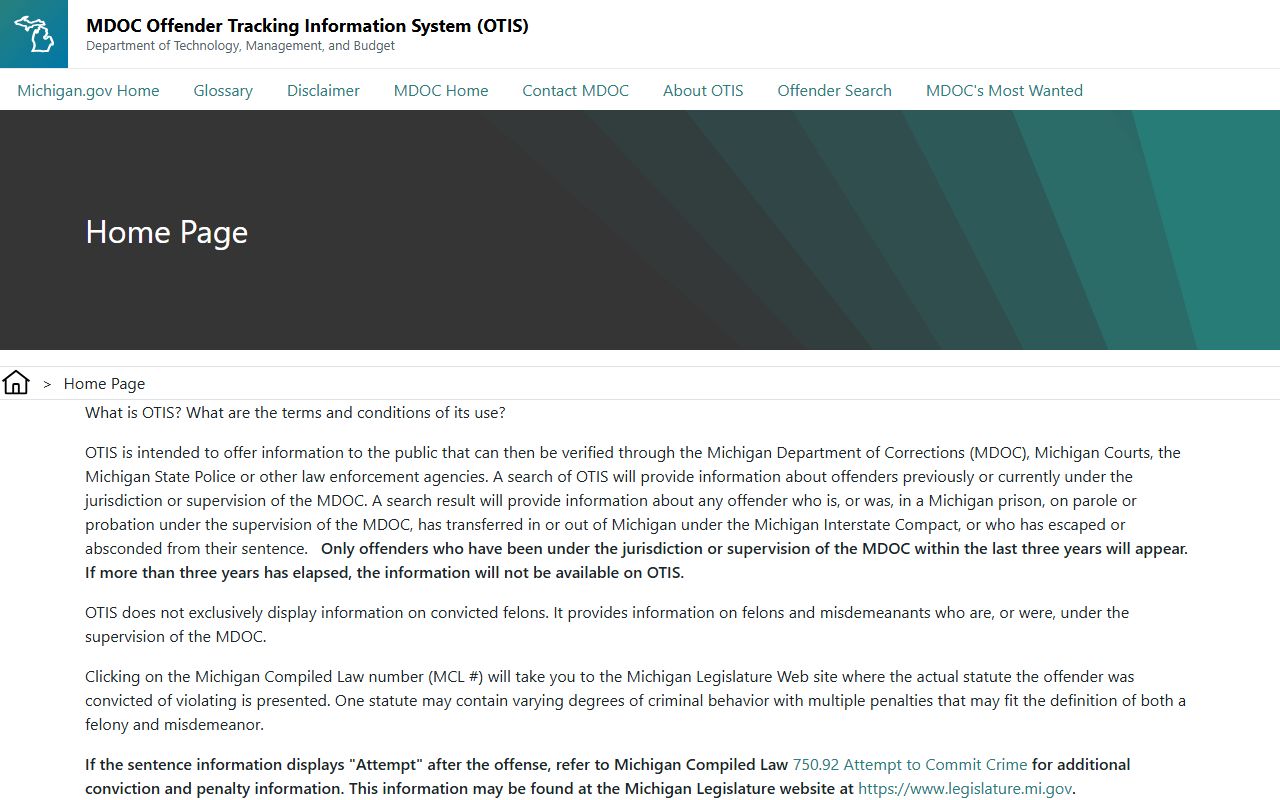
Some charges roll up into statewide systems once a case moves past the county level. The Michigan Department of Corrections runs the Offender Tracking Information System, or OTIS, which covers state prisoners, parolees, probationers, and people discharged within roughly three years. OTIS does not list county lockup inmates, so it is a supervision and conviction lookup rather than an arrest search.
The Michigan OTIS overview explains who the system covers and how its records are limited. That scope matters for Keweenaw County, since a recent arrest with pending charges will not appear in OTIS unless the person is already under state supervision.
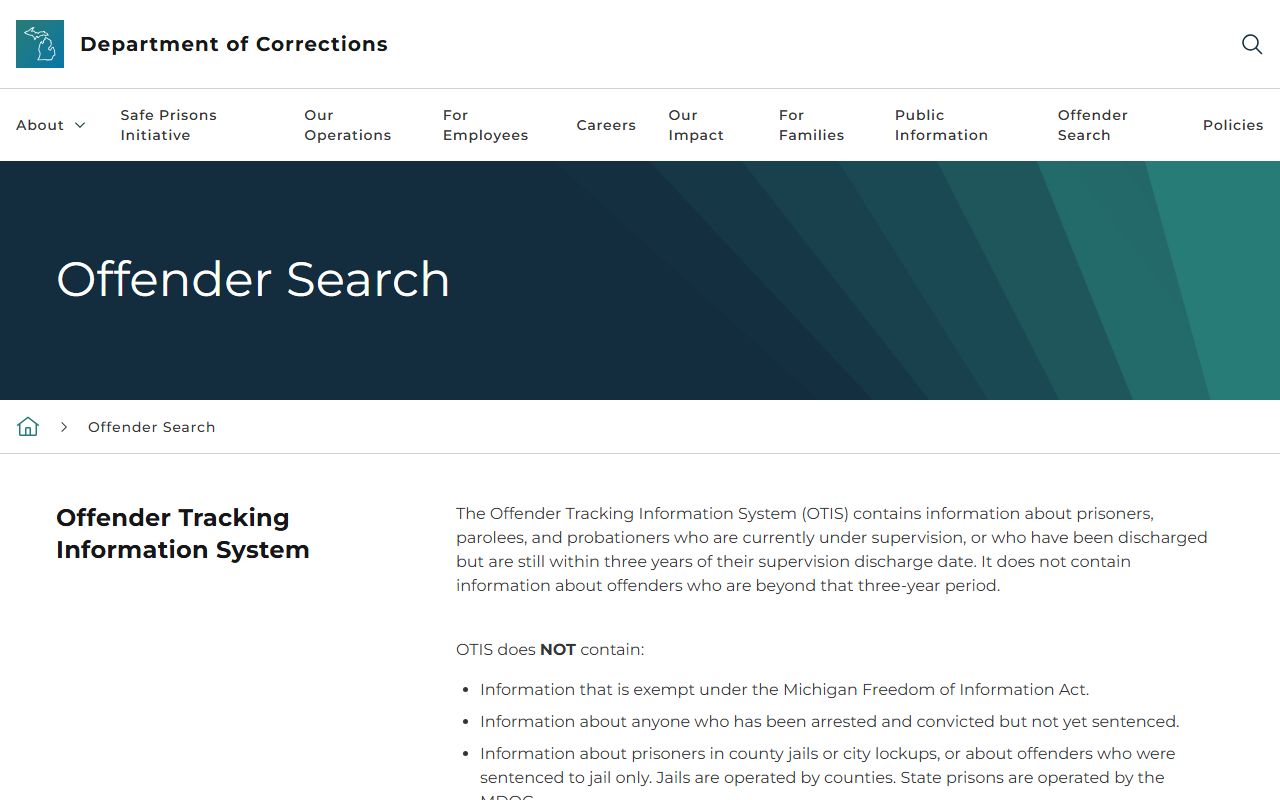
To run a name check, the OTIS search portal asks for at least a last name or an offender number and returns the person's current status, supervision location, and public conviction detail. At the court level, the 12th Circuit Court also offers a criminal name search for a $10.00 fee per name, which is a separate way to confirm charges tied to a specific person.
Pairing OTIS with the court case index gives a fuller picture: the court file shows the charges and their status, while OTIS shows whether a conviction led to state supervision.
Keweenaw County Sheriff Records vs. Court Charges
The arrest itself lives on the law-enforcement side. Incident reports, arrest reports, and other Sheriff's Office records are executive-branch public records, separate from the court's charge file. When one of these records is not posted online, the route is a written request through the Sheriff's Office.
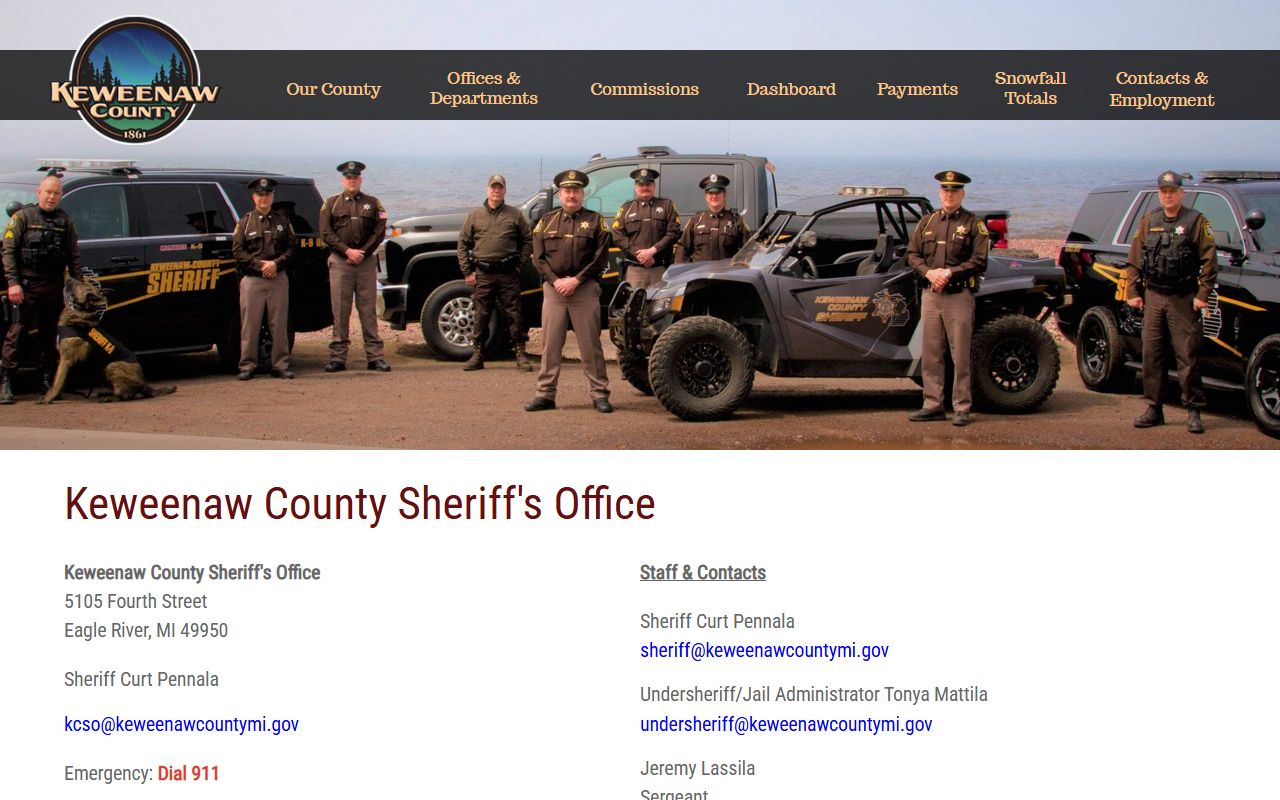
The lead-in image below links the office page that hosts the request form. Use the Keweenaw County Sheriff's Office page to reach the FOIA request form, which asks for your name, mailing address, phone, and a specific description of the record, including complaint numbers, file numbers, dates, and locations when known.
A Sheriff's FOIA request is the right tool for a law-enforcement record, but not for a court case file. The Michigan Attorney General FOIA page explains that the judiciary is excluded from the state FOIA public-body definition, which is confirmed in MCL 15.232. For the charges themselves, work through the court clerk, and for the arrest report, work through the Sheriff's Office.
Public Defender Channel for Charged Defendants
Anyone charged after an arrest has the right to counsel, and a defendant who cannot afford a lawyer may qualify for appointed defense. The Tri-County Public Defenders office serves Houghton, Baraga, and Keweenaw Counties and was formed in 2018 as part of Michigan's public-defense funding reforms.
Appointment is a court process, not a records request. A defendant asks the court to appoint counsel, and the court reviews eligibility and enters the order. This channel handles the defense of the charges rather than access to the charge record, so a Sheriff's FOIA form is not the way to obtain a lawyer.
Restricted Charge Records in Keweenaw County
Not every charge is open to public search. Juvenile charges are restricted, and in Keweenaw County the part-time probate judge handles juvenile matters locally under MCL 712A.28, which limits who may view those files. Some dismissed, acquitted, or nolle prosequi charges can also be made nonpublic under Michigan court rules.
Convictions can leave the public view too. Michigan calls expungement setting aside a conviction, governed by MCL 780.621, and the state's Clean Slate expansions allow eligibility for a limited number of felonies and unlimited misdemeanors, with exclusions such as certain assaultive and weapons offenses. A person files in the court of conviction, so misdemeanor set-asides route through the 97th District Court and felony set-asides through the 12th Circuit Court. A granted set-aside removes the case from ordinary public criminal-record views to the extent the statute allows, though it does not control every private database.