
How to Search Keweenaw County Court Records
The main online tool for Keweenaw County court records is MiCOURT Case Search, the statewide portal run by the Michigan judiciary at micourt.courts.michigan.gov/case-search. It is free, and it lets the public look up case information by court location, case number, or party name. Public web results are limited, though. The Michigan Courts records-management page says the web-accessible categories are the case number, party names, and the case history, also called the register of actions.
One rule sets the whole search in motion: the local court that owns the case type also owns the record. The 12th Circuit Court handles felony criminal cases, civil lawsuits over $25,000, divorce, paternity, custody, parenting time, and personal protection orders. The 97th District Court handles misdemeanors punishable by up to one year, traffic and civil infractions, small claims up to $6,000, civil cases up to $25,000, and landlord-tenant matters. The Probate Court handles estates, trusts, guardianships, conservatorships, and mental-health commitments, plus the county's juvenile and family work through its part-time probate judge. Know the case type before you search, and you will know which office to call if the file is not online.
Before you begin, gather what you know about the case. A case number pulled from a citation, notice, or clerk letter gives the cleanest result. If you only have names, use the exact spelling and pair a first and last name to narrow a party search.
- Identify the case type and the court that owns it: Circuit, District, or Probate.
- Open MiCOURT Case Search and select the correct court or court location.
- Enter the case number if you have it, or search by party or business name.
- Open the case summary and read the register of actions as an index to the file.
- Call or visit the owning court for certified copies, older files, or documents that are not online.
The lead-in image below links to the Michigan Freedom of Information Act public-policy statute, which frames why access to public records matters. Review MCL 15.231 on the Michigan Legislature site to see the state's stated policy in favor of open records.
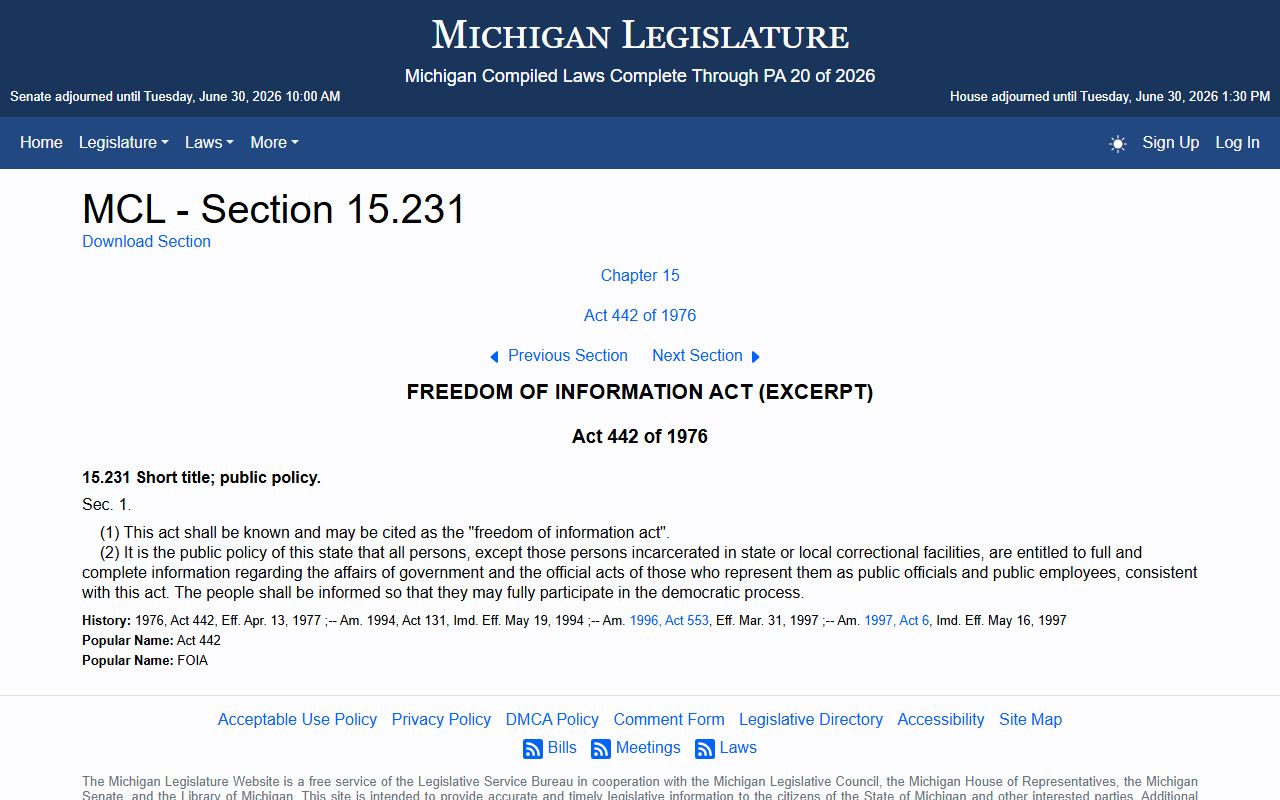
That policy sets the backdrop, but judicial records follow their own court rules rather than the executive-branch FOIA process, which is why the search almost always starts with the court clerk.
Keweenaw County Court Records Search Fields
MiCOURT Case Search is a JavaScript application that asks you to pick a court first, then enter one or more search values. The public version supports case-number and party-name lookups. A separate secured search that includes date of birth is limited to authorized individuals approved by the State Court Administrative Office, so ordinary users should not expect a birthdate field to work. The table below lists the fields the public portal presents.
| Field Label | Type | Required | Notes / Format |
|---|---|---|---|
| Court / court location | Dropdown selector | Yes | Choose the Keweenaw County court before searching. |
| Search by case number | Text | Conditional | Best for exact lookup; use the number from a notice, citation, or docket. |
| Search by party name | Text | Conditional | Public search supports party-name lookups. |
| First name | Text | Conditional | Pair with a last name to narrow a person search. |
| Last name | Text | Conditional | Use exact spelling; data may reflect the filing name. |
| Business name | Text | Conditional | Used for entities in civil or collection cases. |
| Case type / category | Dropdown filter | No | Civil, traffic, criminal, domestic, and probate may appear by court. |
| Date of birth | Secured field | Not public | Limited to SCAO-approved authorized users. |
| hCaptcha | Challenge | When shown | Verifies the request; complete it before results load. |
| Search / Reset | Buttons | n/a | Runs or clears the entered criteria. |
Types of Keweenaw County Court Records
The record you find depends on the court that created it. Because Keweenaw County routes different case types to different courts, the same portal can return a civil judgment, a criminal disposition, a divorce decree, or a probate filing. Knowing the categories helps you read a result and decide whether the online summary is enough or whether you need the full file from the clerk.
These are the main categories the county courts produce. Public access varies by category, and some files are restricted or sealed by law.
- Circuit civil records: lawsuits over $25,000, personal protection order files, judgments, motions, and orders.
- District civil records: small claims up to $6,000, landlord-tenant, eviction, and garnishment files.
- Criminal records: felony files in Circuit Court and misdemeanor, arraignment, and bond entries in District Court.
- Domestic and family records: divorce, paternity, custody, and parenting-time cases in Circuit Court, with sensitive details often redacted.
- Probate records: estates, trusts, guardianships, conservatorships, and mental-health commitments.
- Traffic records: civil infractions and traffic misdemeanors handled through the District Court and Magistrate Office.
Juvenile, adoption, and mental-health matters are handled through the Probate Court but carry access limits under Michigan law, so they do not surface as ordinary public search results. For an event-by-event view of any case, the Keweenaw County court dockets reproduce the register of actions described in the next section.
What Keweenaw County Court Records Show
A single case record is a bundle of data points. At the center is the register of actions, the chronological log of every event in a case, from the complaint filed to the final judgment or sentence. Michigan Court Rule 8.119 governs how courts keep these records and registers of actions and how the public may access them. The field inventory below shows the parts of a typical Keweenaw County case record and what each part tells you.
| Field | What It Shows |
|---|---|
| Case Number | The unique identifier the court assigns when a case is filed; the fastest search key. |
| Court / Location | Whether the file sits with the Circuit, District, Probate, or Magistrate function. |
| Party Names | Plaintiff and defendant, petitioner and respondent, or decedent and estate, by case type. |
| Filing Date & Case Type | When the case opened and its category: civil, criminal, traffic, domestic, or probate. |
| Register of Actions | The dated docket log: complaint, summons, service, hearings, motions, orders, and judgment. |
| Hearing Details | Date, time, judge or magistrate, hearing type, and courtroom or remote link. |
| Financial Details | Filing fees, fines, costs, restitution, bond, judgment amounts, and payment status. |
| Disposition | The final result or current outcome of the case or charge. |
| Redactions | Removed items such as Social Security numbers, minor names, and protected addresses. |
The image below links to the Michigan FOIA definitions statute, which explains why the county clerk acting as circuit-court clerk is treated as part of the judiciary rather than a FOIA public body. See the definitions in MCL 15.232 for that distinction.
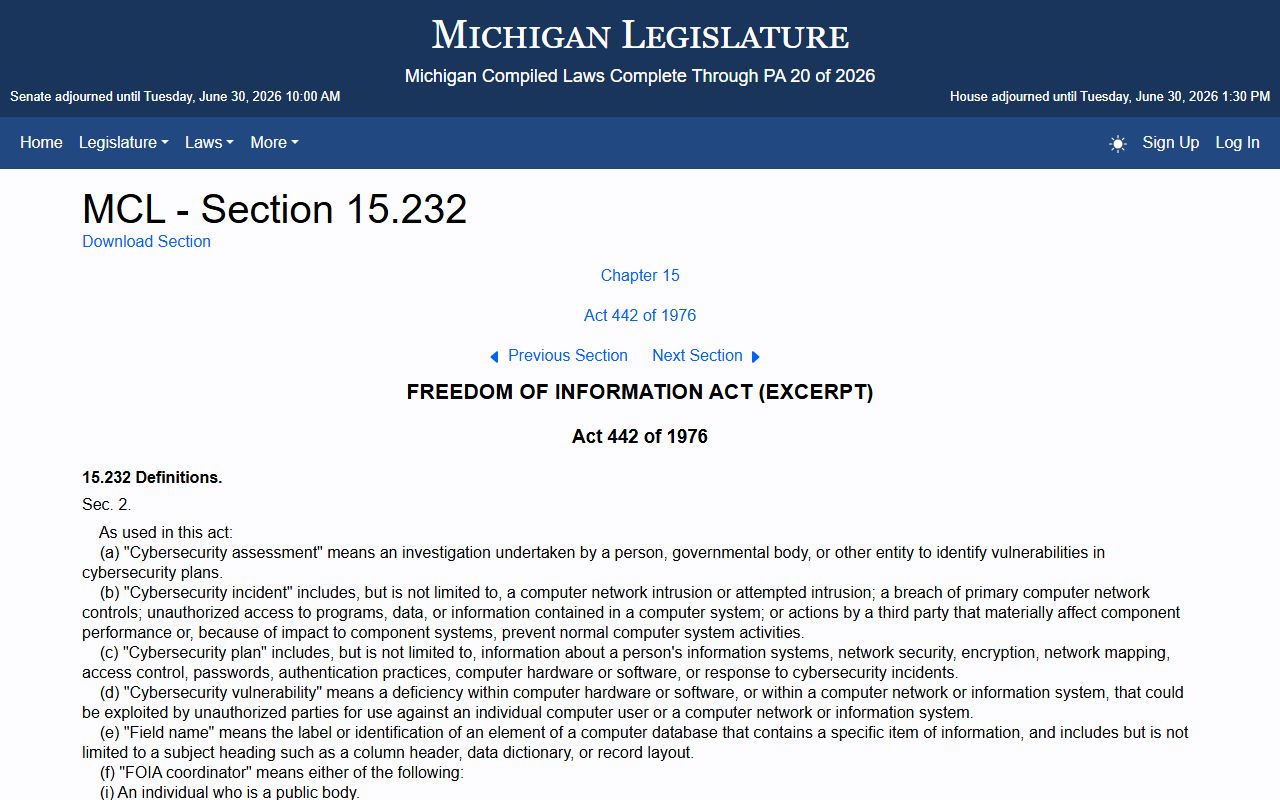
That definition is the reason a court case file is requested through the clerk and court rules, while a sheriff's incident report follows the FOIA process instead.
Public Access Framework for Keweenaw County Court Records
Michigan draws a clear line between court records and executive-branch public records. The Freedom of Information Act, at MCL 15.231, sets a public policy favoring access to the records of public bodies. But MCL 15.232 defines "public body" in a way that excludes the judiciary, including the county clerk when acting as clerk of the Circuit Court. So a court case file is not a FOIA record. You obtain it from the court clerk under the court rules, not through a FOIA request.
FOIA still governs Sheriff's Office records and other executive-branch files. When it applies, MCL 15.235 gives a public body five business days to respond, with one possible ten-business-day extension, and MCL 15.234 allows the body to charge fees for search, review, and copying. Written FOIA requests must give a complete name, address, and a valid phone or email, and must describe the record clearly enough to find it.
The image below links to the FOIA response-deadline statute. Read the timeline in MCL 15.235 before you send a request to a non-court office.
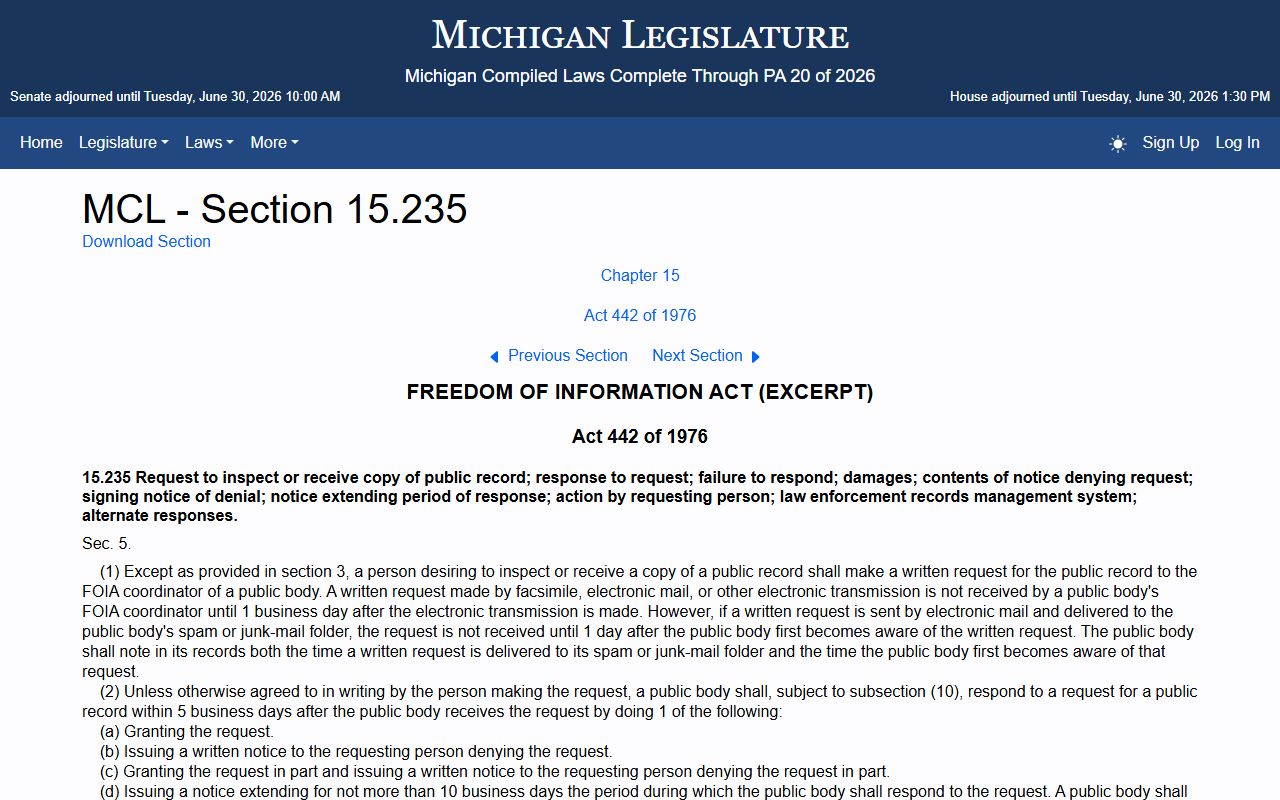
Those deadlines apply to sheriff and county-office records, not to court case files, which move on the court's own copy and certification schedule.
Note: Court case files are requested from the clerk under Michigan Court Rule 8.119, not through a FOIA request, because the judiciary is excluded from the FOIA public-body definition.
Records That Are Sealed or Confidential in Keweenaw County
Not every court file is open. Michigan law and court rules make several categories nonpublic. Juvenile records are restricted under Michigan's set-aside statute and related juvenile-access rules, and Keweenaw County handles juvenile matters locally through the part-time probate judge. Adoption records are confidential under statute. Mental-health commitment files handled by the Probate Court are sensitive and restricted. Across all case types, personal identifiers such as Social Security numbers, financial account numbers, protected addresses, and the names of minors are redacted or sealed.
Convictions can also leave the public record. Michigan calls expungement "setting aside" a conviction. If a court grants a set-aside under the criminal set-aside statute, the case is removed from ordinary public court and criminal-history views to the extent the law allows. To pursue one, identify the exact conviction, court, case number, and sentence date, then file in the court where the conviction entered: the 97th District Court for misdemeanor and traffic-criminal convictions, or the 12th Circuit Court for felonies. A set-aside order controls only official court and state records, not private databases.
The image below links to the Michigan FOIA fee statute, useful when a related sheriff or county record does carry a copying charge. See the fee rules in MCL 15.234.
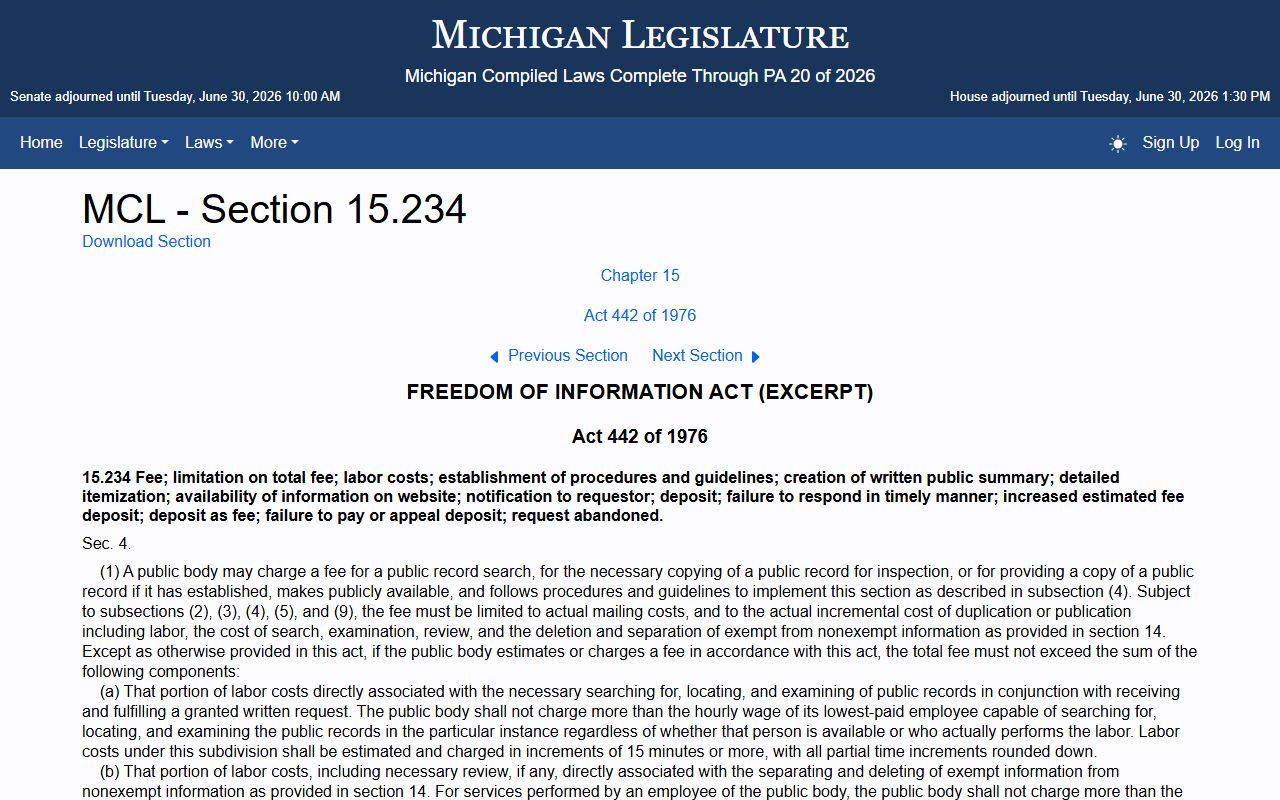
Court certified-copy charges are set by the court rather than by the FOIA fee statute, so confirm the amount with the clerk before you order.
Ways to Access Keweenaw County Court Records
Because Keweenaw is a small, rural county, several records never appear in an online database. When the portal comes up short, use the fallback chain: the correct court by case type, the phone line, certified copies from the clerk, the Sheriff's FOIA form for law-enforcement records, and the state archives for very old files. The county courthouse in Eagle River houses the Circuit, District, Probate, and Magistrate functions along with the County Clerk, so specify the office by case type rather than simply asking for "the courthouse."
Start at the counter or by phone for certified copies, plain copies, older files, and fee questions. The Circuit Court, District Court, and County Clerk share one line at 906-337-2229; the Probate Court uses 906-337-1927. Payments can be made by mailed check or money order, in person by cash or card, and, for the Circuit Court, online at any time. For a law-enforcement record such as an incident report, use the Keweenaw Sheriff's Office FOIA form instead, since that is an executive-branch record and not a court file. The County Clerk and Register of Deeds is the office to contact for certified circuit-court copies.
Keweenaw County Courthouse
5095 Fourth Street
Eagle River, MI 49950
906-337-2229
Monday to Friday, 9:00 a.m. to 4:00 p.m., closed legal holidays
Winter weather can close the building, so the county advises verifying that the courthouse is open before a long drive during a storm. Federal matters follow a separate path. Bankruptcy filings for the Upper Peninsula are handled by the U.S. Bankruptcy Court for the Western District of Michigan, not the county courthouse. Visit the Western District bankruptcy court site to see how that federal docket works.
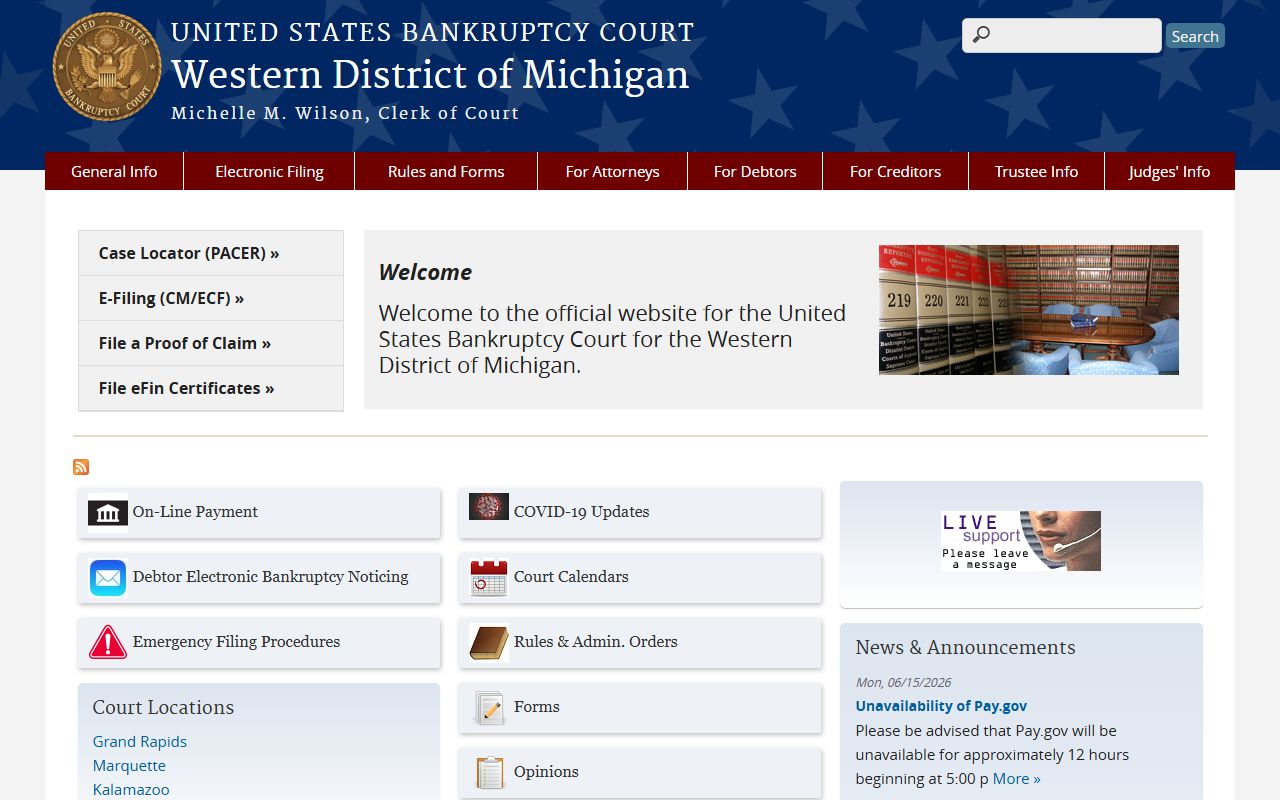
Federal bankruptcy and district-court records live in the PACER and CM/ECF systems, which is a reminder that a county court search will not surface federal cases.
Historical Keweenaw County Court Records
Older court files predate the online era by more than a century. Keweenaw County was organized in 1861, and its earliest court records are held by the Archives of Michigan. The Archives Keweenaw County guide lists specific record groups and year ranges, which makes it the right starting point for genealogical or historical research. These files are not in MiCOURT, so a researcher works from the archives inventory and, where the guide points to it, the Michigan Technological University Archives and Copper Country Historical Collections.
The Archives guide documents chancery, circuit, and jail holdings from the county's mining-era history:
- Chancery case files
- 1873 to 1923, with related chancery calendars, decree, order, record, and rule books spanning 1862 to 1962.
- Circuit Court case files
- 1861 to 1952, the core body of early trial-court litigation.
- Circuit Court docket
- 1867 to 1906, with a circuit journal running 1880 to 1937.
- Jail record
- 1874 to 1959, a long-run custody log from the copper-mining decades.
- Naturalization records
- Certificates, declarations, order books, petitions, and second papers from 1862 to 1954 by series.
Coroner's dockets, order books, and other circuit records fill out the collection, much of it tied to the copper-country communities that grew around the mines. For a modern case, though, MiCOURT and the local clerk remain the first stops, and the archives step in only when the file is decades old.